Why accurate weight knowledge is fundamental to safe and efficient precast construction
In precast construction, the weight of each element is not a minor detail. It is a primary design and planning parameter that influences almost every stage of a project. When a precast concrete element leaves the casting yard, its weight affects:
- The foundation engineer calculating bearing pressures and designing support conditions
- The crane operator selecting plant and assessing lift feasibility
- The logistics coordinator planning transport routes and securing over‑mass permits
Accurate weight information directly influences safety, program, and cost. However, weight is often treated as a secondary check during shop drawing review, rather than a design driver to be considered from concept stage.
This article will:
- Explain what contributes to the weight of a precast concrete element
- Outline typical weight ranges and influencing factors
- Show how weight affects design, transport, and installation planning
- Present practical strategies for managing and optimising element weight
By understanding these concepts, project teams can make more informed decisions and reduce risk across the entire precast workflow.
What determines the weight of a precast concrete element?
The weight of a precast element is governed by both its geometry and its materials. While the volume of concrete is the most obvious factor, several other variables also have a measurable impact.
Concrete volume
The starting point is the element’s volume:
> Weight ≈ Volume of concrete × Density of concrete
As cross‑sections become thicker or elements become longer or wider, weight increases proportionally. Early geometric decisions, such as panel thickness or culvert wall thickness, therefore have a first‑order effect on weight.
Reinforcing steel content
Reinforcing steel is significantly denser than concrete. As a guide:
- Typical concrete density: ~2.4 t/m³
- Reinforcing steel density: ~7.8 t/m³
This means that:
- Heavier reinforcement (more bars, larger diameters, or tighter spacing) will increase element weight
- Highly reinforced regions, such as corbels, lifting zones, or connection details, can add more mass than is sometimes allowed for in preliminary estimates
When comparing different design options, it is useful to check not just concrete volume but also estimated reinforcement mass.
Cement content and concrete strength
Concrete strength is strongly influenced by the cement or supplementary cementitious material (SCM) content of the mix. Because cement is typically denser than the sand and coarse aggregate components, higher strength mixes often have slightly higher densities.
Key points:
- Higher strength concrete generally results in slightly heavier concrete per cubic metre
- This affects both element weight and the maximum volume that can be carried in an agitator truck before reaching legal mass limits
In high‑strength applications, it is good practice to confirm assumed concrete density with the precaster or concrete supplier, rather than relying on a generic value.
Aggregate and sand type
The density of the aggregates and sands used in the mix design can vary depending on:
- Source rock type (e.g. basalt, granite, limestone)
- Grading and moisture content
While these variations are generally smaller than the effect of reinforcement, they can still contribute to differences between nominal and actual element weight.
Alternative and lightweight mix designs
Some advanced mix designs deliberately alter density. For example:
-
- Ultra lightweight concrete (ULC) can use lightweight aggregates, fillers, and aeration
-
- These concretes can be less than half the weight of conventional concrete
Such mixes can significantly reduce element weight, which may:
- Enable larger units within transport or crane limits
- Reduce foundation loads
However, lightweight mixes come with their own design, durability, and cost considerations that must be evaluated carefully.
Understanding weight tolerances
In practice, the “as‑cast” weight of a precast element rarely matches the theoretical weight exactly. Variations can arise from:
- Concrete density differences between batches
- Dimensional tolerances in casting
- The mass of cast‑in items such as ferrules, lifting anchors, plates, and ducts
A typical variation in element weight can be ±5% or more.
For this reason:
- Design calculations should include a margin above the nominal weight
- Crane load assessments must consider an allowance for maximum possible element mass, not just calculated weight
- Transport permits should be based on upper‑bound weight estimates
In Australia, AS 3850 provides guidance on dimensional and manufacturing tolerances applicable to precast construction, and these tolerances should be considered when planning lifting and transport.
Why does weight matter so much in practice?
While self‑weight is an important input to structural design, its impact on construction planning is often more immediate. Incorrect weight assumptions can contribute to:
- Lifting incidents and near‑misses
- Transport non‑compliance
- Delays due to needing different cranes or vehicles at short notice
Three key areas are particularly sensitive to element weight:
Within the precast facility
Precast manufacturers have:
- Defined maximum lifting capacities in casting and storage yards
- Specific handling equipment and crane configurations
If an element exceeds in‑house lifting capacity:
- Additional mobile cranes may be required, increasing cost and complexity
- Storage layouts and handling sequences may need to be revised
Early confirmation of target element weights helps the precast facility plan moulds, lifting arrangements, and storage safely and efficiently.
Transport to site
In Australia, road transport is governed by strict mass and dimensional limits, regulated by the National Heavy Vehicle Regulator (NHVR). Weight directly affects:
- Vehicle selection
- Permit requirements
- Route options and travel windows
Key considerations include:
- Standard general access vehicle combinations are limited to 42.5 tonnes gross vehicle mass
- Heavier loads may require Performance‑Based Standards (PBS) assessment or route‑specific permits
- Longer or heavier elements may need multi‑axle semi‑trailers, escort vehicles, or restricted travel times (e.g. night or off‑peak)
Design decisions are often influenced by these constraints. For example:
- It may be more cost‑effective to reduce the size of individual elements and increase the number of units, in order to maximise trailer utilisation and reduce permit complexity
- In some cases, elements are deliberately split into two pieces to comply with transport weight limits, even when a single piece would be structurally preferable
Delivery sequencing must also be coordinated with crane operations:
- Loads should arrive in an order that aligns with the installation sequence
- Poor alignment can lead to double handling, extended on‑site storage, and increased risk of damage or instability
Unloading and installation on site
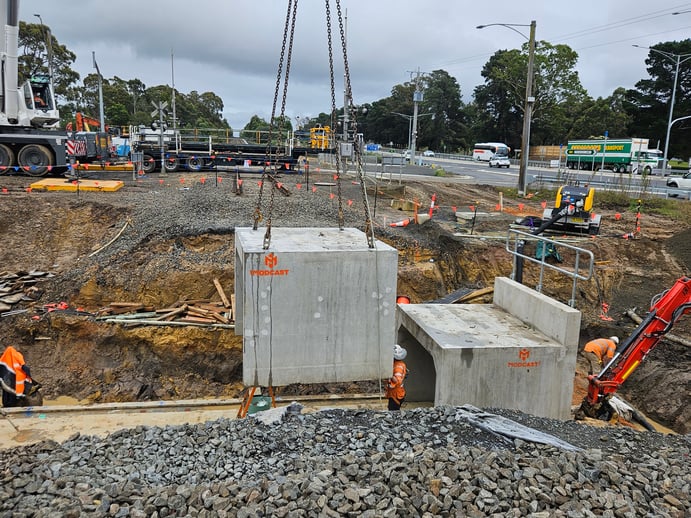
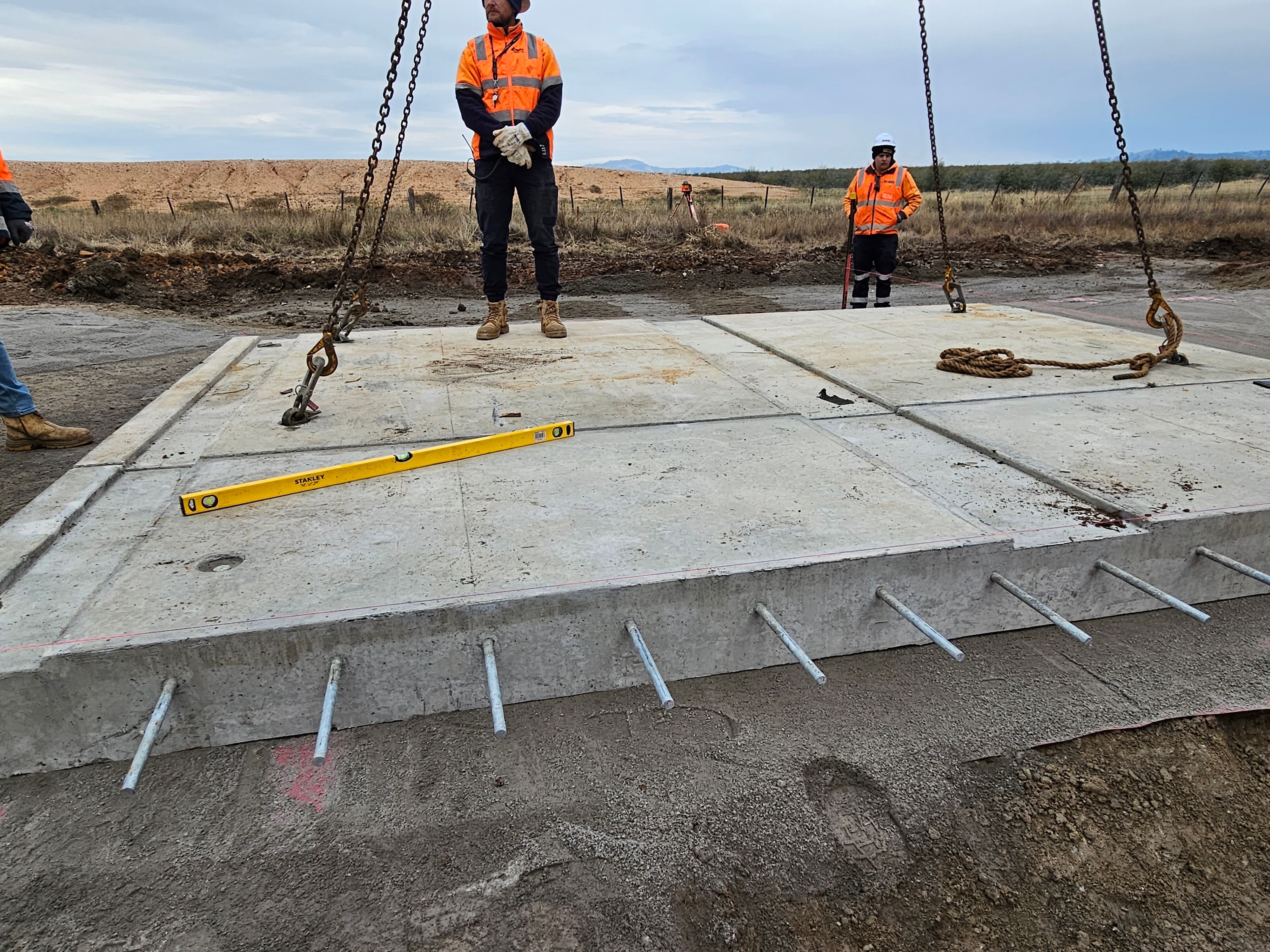
Lifting on site is where element weight is felt most directly. Safe and efficient installation requires:
- Early consultation between the precast designer, installer, and crane operator
- A clear lifting plan that reflects actual weights, not estimates
Factors that need to be considered include:
- Site access and crane pad locations
- Ground bearing capacity under crane outriggers or tracks
- Overhead obstructions (power lines, bridges, existing structures)
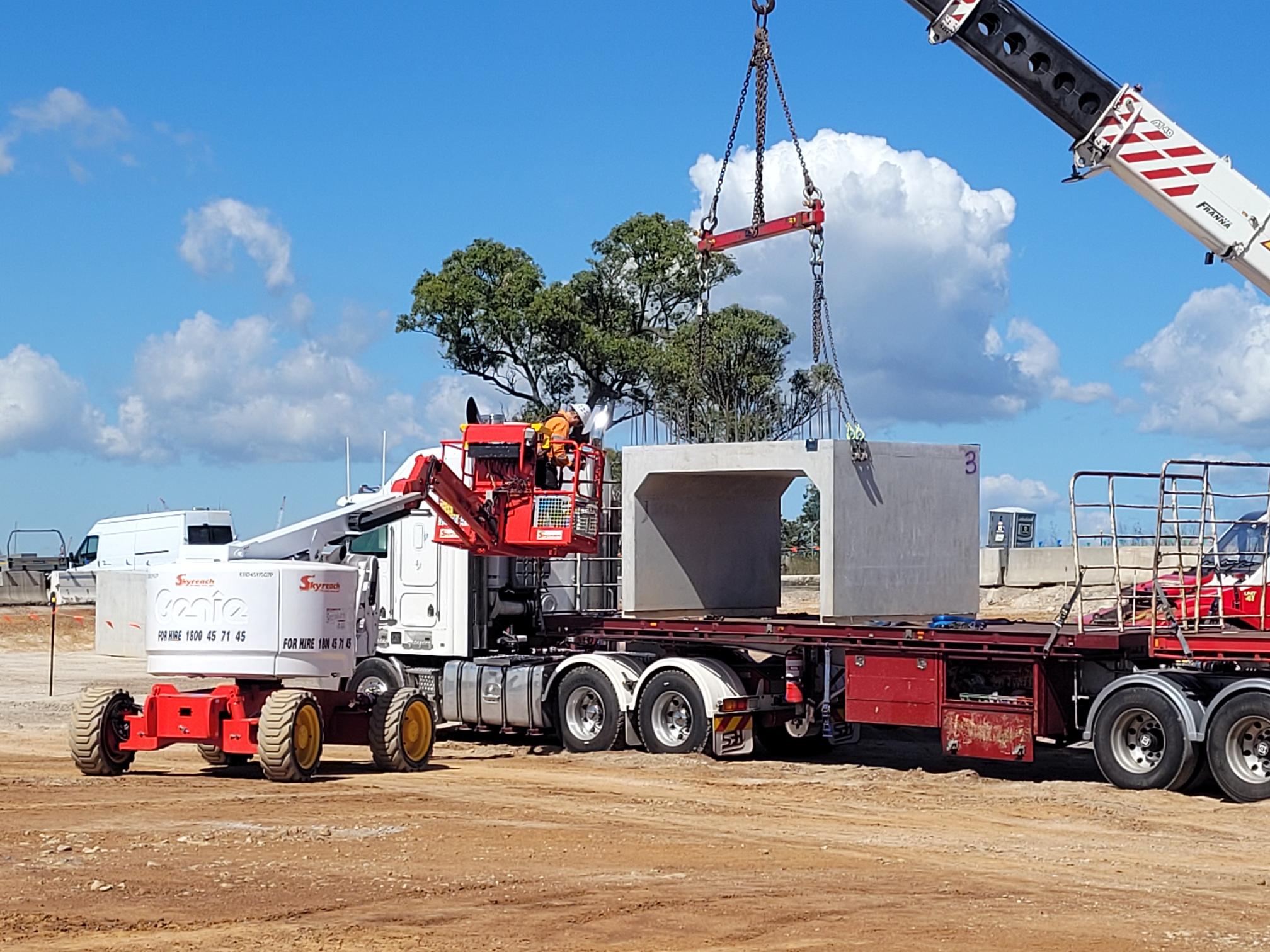
- Type of lifting equipment (mobile cranes, frannas, excavators with lifting attachments)
- Reach required to both unload from trucks and place into final position
- Truck positioning to allow safe unloading within crane operating limits
- Any on‑site rotation required (e.g. elements transported on their side then rotated upright before placement)
Each of these factors interacts with element weight to determine safe crane selection.
Key considerations in crane selection
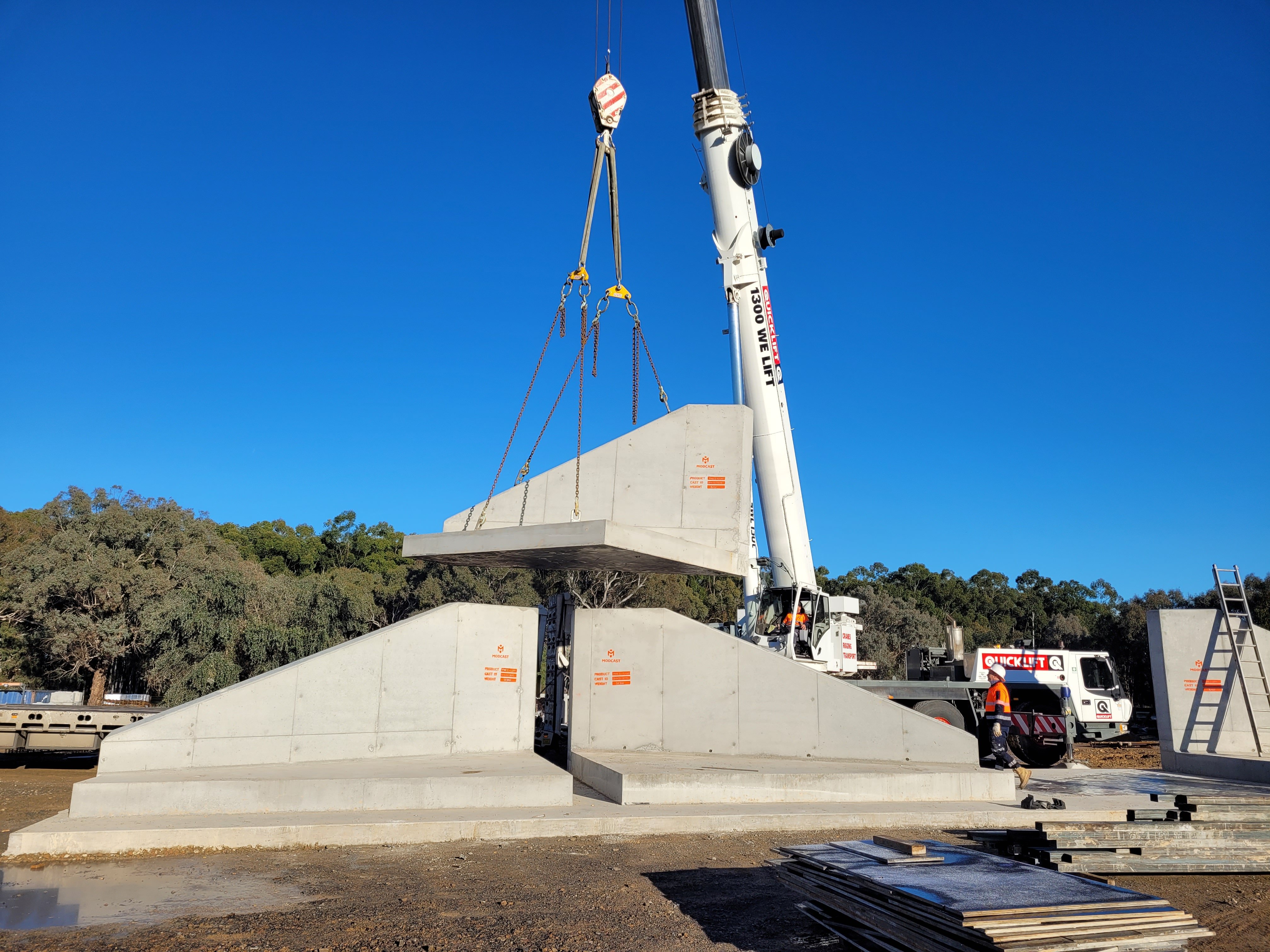
Crane capacity is not a single number; it varies with configuration and lift geometry. Three main parameters govern crane selection:
1. Element weight (including rigging)
2. Lift radius (horizontal distance from crane centre to lift point)
3. Lift height (vertical distance to final placement)
These determine the required capacity “on the chart” at the critical points of the lift.
Important educational points for planning lifts:
- Load charts are radius‑dependent
- A crane that can lift a given weight at 10 m radius may not be able to lift the same load at 20 m
- Planners must check weight against the worst‑case radius for each element, not just a typical case
- Rigging weight must be included. Spreader beams, equalising beams, chains, slings, shackles, and lifting clutches all contribute to total load. Rigging mass is frequently underestimated in early planning. For heavy elements, rigging can add several hundred kilograms or more
- Lifting insert capacity and safety factors. Cast‑in lifting anchors and clutches must be rated for the full element weight with appropriate safety factors. AS 3850 typically requires minimum safety factors (often 3:1 or higher, depending on the lifting system and conditions)
- Lifting design should consider load sharing between inserts, dynamic effects, and any bending induced during handling
Strategies for managing and optimising element weight
Weight should be treated as a controllable design variable rather than an output checked at the end. Projects that treat weight management as a core objective typically achieve safer, more predictable delivery.
Engage the precaster early
Precast manufacturers can:
- Provide realistic weight data based on previous projects and standard product ranges
- Advise on practical limits for lifting and transport from their facility
- Suggest alternative profiles or configurations that reduce weight while maintaining performance
By consulting the precaster during concept and preliminary design, structural engineers can:
- Align assumptions with real, buildable elements
- Avoid designs that later prove difficult or costly to handle and transport
Use BIM or 3D modelling for weight scheduling
Accurate 3D models that capture:
- True element geometry
- Voids, rebates, and service penetrations
- Facing materials and architectural features
BIM modelling can automatically generate weight schedules. These should be:
- Reviewed by both the structural design team and the construction planning team
- Updated through each design stage as details change
- Cross‑checked against precaster shop drawings and production data
This approach helps identify any elements that may exceed handling or transport limits early, when design changes are still relatively simple to implement.
Optimise element profiles
Several standard strategies exist to reduce mass while maintaining structural capacity, such as:
- Hollow‑core or voided sections
- Ribbed or cellular profiles
- Tapered or haunched regions where full thickness is not required along the entire span
When selecting profiles, it is important to consider:
- Structural performance and serviceability
- Ease of manufacture and consistency with available moulds
- Handling and lifting requirements
- On‑site connection details and temporary stability
Collaboration between structural designers, precasters, and installers helps ensure that weight‑efficient profiles remain practical to build and handle.
Build weight tolerances into all planning
Because element weights can vary from nominal, all planning should include a margin above calculated values. This applies to:
- Transport permits and vehicle loading calculations
- Crane load charts and lift plans
- Temporary works design, including propping and back‑propping
- Handling procedures within the precast yard and on site
Using a conservative design weight helps create a buffer against variability and reduces the likelihood of last‑minute changes.
Conclusion: treating weight as a critical design parameter
The weight of a precast concrete element is the outcome of material choices, geometric decisions, and manufacturing tolerances. It influences:
- Structural design and support conditions
- Handling in the precast yard
- Transport compliance and cost
- Safe and efficient lifting and installation on site
Engineers who treat element self‑weight as a precise, verifiable input rather than a rough estimate produce more reliable designs. Construction planners who incorporate realistic weight information from the earliest program stages are less likely to encounter unexpected lifting or transport issues.
When project teams:
- Engage their precaster early
- Use model‑based weight schedules
- Plan with allowances for tolerances and rigging
- Integrate lifting and transport considerations into design decisions
they transform weight management from a constraint into a planning advantage.
In precast construction, accurate weight underpins accuracy in every subsequent decision. For guidance on precast concrete weights and to plan your next box culvert or custom precast project, you can contact the team at Modcast for project‑specific advice.